

Design Thinking is a human-centered approach to innovation that transforms complex problems into concrete solutions. By balancing desirability, feasibility, and viability, this method reduces the risk of failure through empathy and rapid prototyping.
Key takeaways
|
The concept of design thinking was theorized as early as 1969 by Herbert Simon, who defined it as a way of thinking capable of solving concrete problems. This innovative approach stands out for its ability to reconcile user desirability, technical feasibility, and the economic viability of a project. However, many companies still struggle to transform their ideas into real solutions without wasting valuable resources. We will take a closer look at this iterative methodology to help you integrate collective intelligence and empathy at the heart of your development strategy.
Sommaire
Design Thinking, or the art of human-centered problem solving
Design Thinking, theorized by Herbert Simon and later popularized by Tim Brown (IDEO), relies on empathy, ideation, and prototyping. This Human-Centered Design (HCD) approach balances human desirability, technical feasibility, and economic viability to drive innovation.
This approach radically transforms the business vision by building on solid academic roots.
From Stanford to IDEO: the emergence of a new vision
The history of the concept dates back to the work of Richard Buchanan in 1992 and research conducted at Stanford. Tim Brown’s influence was instrumental in its global adoption. You can explore Roger L. Martin’s thoughts on strategy and design to delve deeper.
Design has evolved from a purely aesthetic vision into a genuine method for problem-solving. Today, it addresses the most complex business challenges faced by modern organizations.
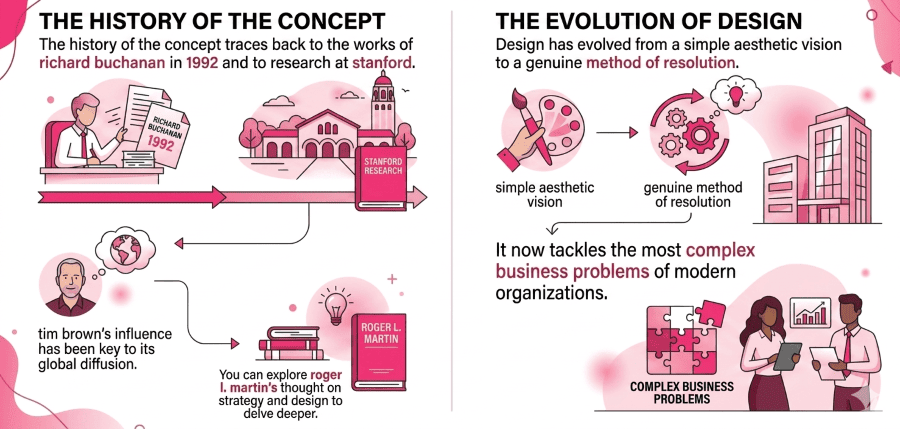
Infographic: Timeline of the evolution of Design Thinking, from its academic foundations at Stanford to its popularization by the IDEO agency.
Three essential pillars support this approach: desirability, feasibility, and viability. Without this balance, innovation risks remaining a dead letter.
Design Thinking is a creative approach to problem-solving that begins with understanding people’s needs, motivations, and behaviors.
The Harvard Business Review article in 2008 marked a major turning point. MIT also offers highly insightful explanations from the MIT Sloan School on this subject. Today, the method integrates artificial intelligence to strengthen human-AI collaboration. This lies at the very heart of IDEO and the Human-Centered Design approach for contemporary challenges.
To better understand this philosophy, we highly recommend reading the Book: “Change by Design” – by Tim Brown. This book serves as a valuable resource.
Success depends above all on establishing a sustainable culture of innovation. Every employee must be able to adopt these creative tools on a daily basis. In short, its iterative nature allows teams to learn constructively from mistakes. We don’t look for immediate perfection, but rather continuous improvement. This historical evolution naturally leads us to explore the very engine of the method: understanding others.
The psychology of empathy at the service of the user
Empathy triggers deep cognitive mechanisms to grasp what another person is feeling. It differs from sympathy because it requires rigorous analytical neutrality. A distinction must be made between passive observation, which consists of watching, and active immersion. The latter requires truly living the experience of the final user.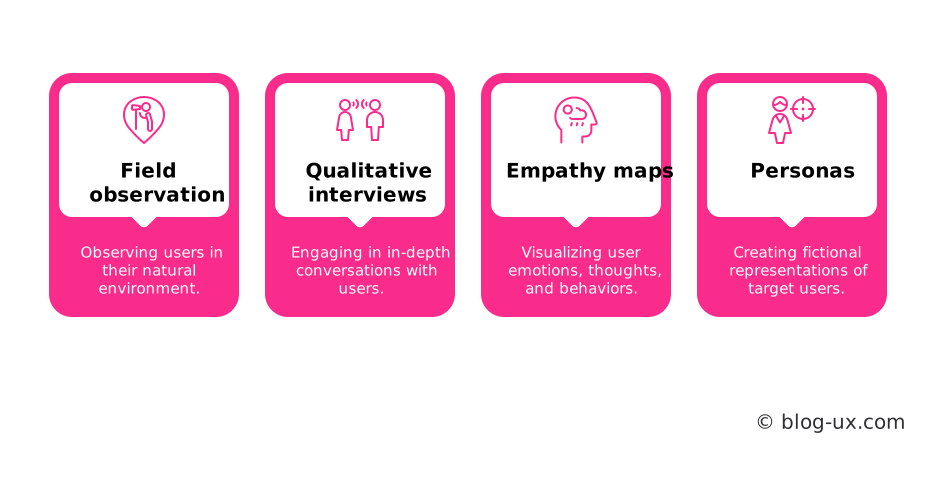 Infographic: The psychological levers of empathy and immersion methods used to decode the user experience.
This phase drastically reduces the risks of commercial failure for companies. It validates real needs even before making heavy investments.
- Field observation
- Qualitative interviews
- Empathy maps
- Personas
For a comprehensive overview, consult our guide on Design Thinking – UX Blog. It details the importance of placing humans at the center. Psychology helps identify user “pain points” or frustrations. Understanding these friction points is the first step toward a relevant solution. The d.school offers specific tools from the Stanford d.school to structure this phase. These methods transform intuition into actionable data. Once these needs are identified, the team can move on to the definition phase. This is where the problem is precisely framed.
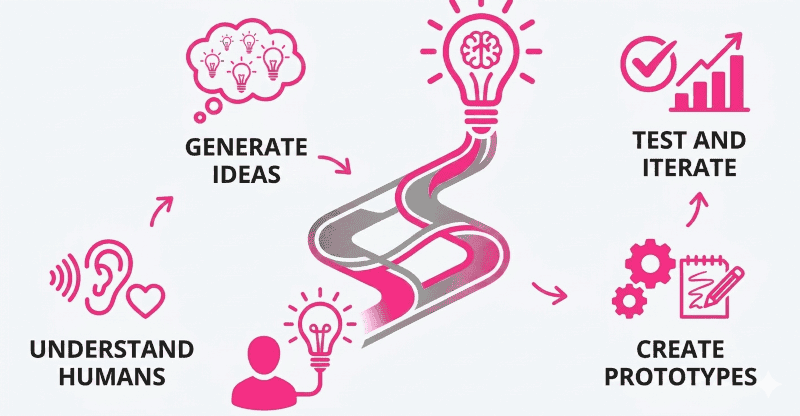
Diagram: Mapping the non-linear and iterative journey connecting the different phases of Design Thinking.
5 steps to transform an intuition into a concrete solution
Moving from theory to practice requires a rigorous structure, often illustrated by the Double Diamond model.
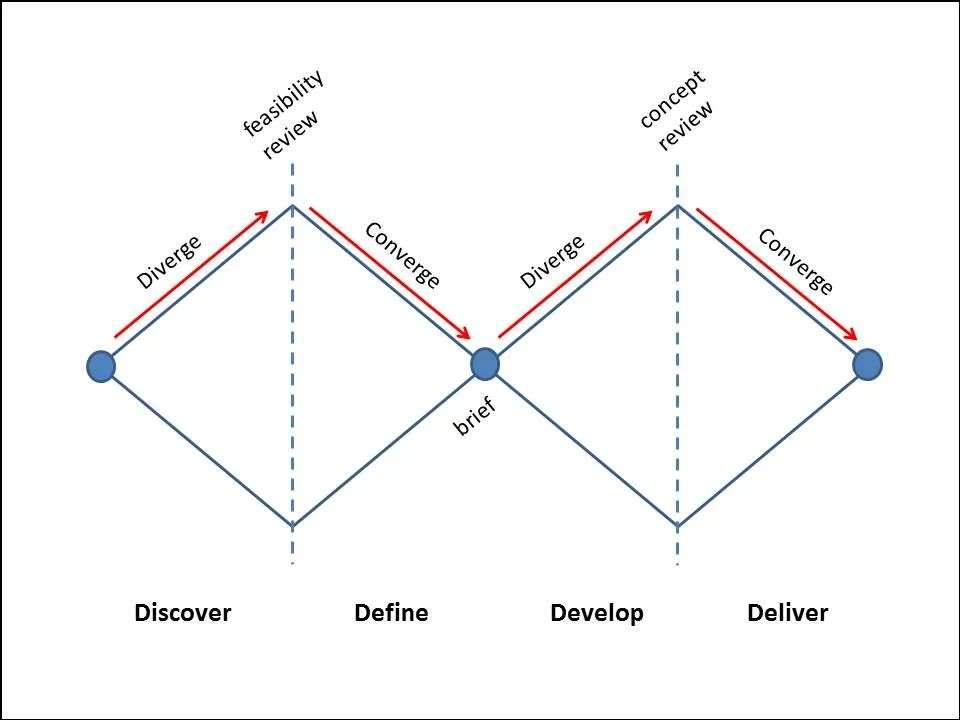
Diagram: The Double Diamond model highlighting the crucial alternations between phases of divergence and convergence.
The Double Diamond model: the phases of divergence and convergence in the design process (Discover, Define, Develop, Deliver). Source: Service Innovation & Design
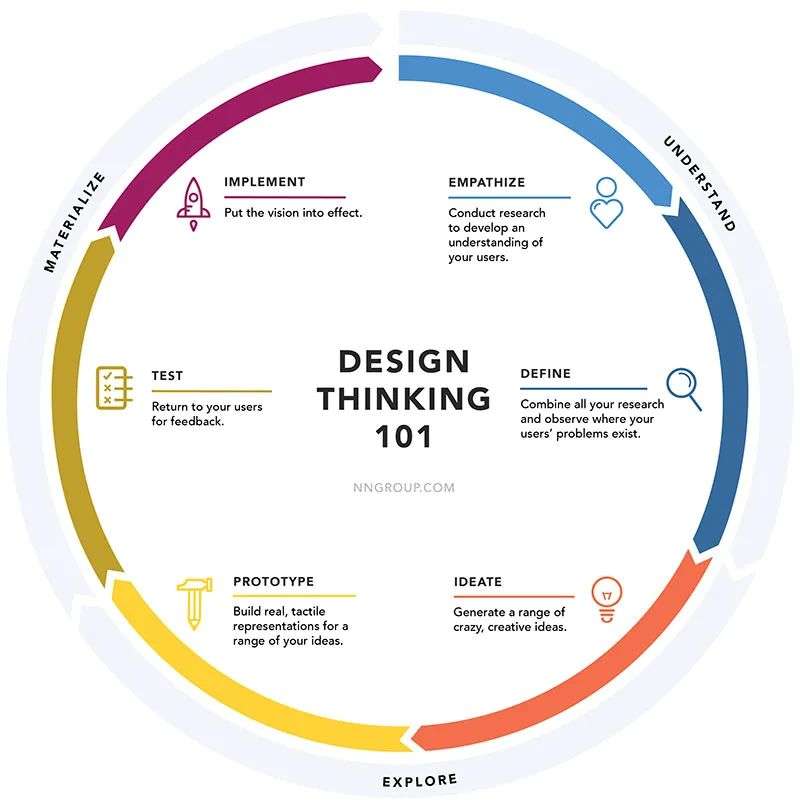
The 6-step Design Thinking cycle (Empathize, Define, Ideate, Prototype, Test, Implement) structured around three main phases: Understand, Explore, and Materialize.
Source: Nielsen Norman Group.
Empathy and definition to uncover the real need
Gathering qualitative data relies on immersion and interviews. We prioritize direct observation to capture authentic user verbatims. These testimonies reveal true frustrations. Next comes the reformulation of the problem through the Point of View (POV). This convergence step synthesizes the research findings. It makes it possible to transform scattered observations into a clear challenge. One must be wary of unverified internal assumptions. To structure this exploration, the Double Diamond process is often used.
This model prevents rushing toward the wrong solution. Certain Design Thinking expressions reflect this mindset perfectly. The idea is to remain focused on the human element. Empathy then becomes a lever for strategic innovation. Using the “How Might We?” question proves fundamental here. It opens up fields of possibilities without imposing immediate constraints. It is the starting point for ideation. Clarity is indispensable before moving on to pure creation. Without a precise definition, the risk of missing the mark is high. Defining the problem well guarantees future relevance.
Ideation and prototyping: giving shape to ideas
Ideation marks the transition from divergent thinking to convergent selection. First, a large volume of ideas is generated. Then, we sort through them to keep only the viable directions. Low-fidelity prototypes, made of paper or cardboard, bring concepts to life. They make ideas immediately tangible. This is an economical way to visualize a complex solution. This rapid prototyping limits unnecessary investments in the wrong directions. We detect mistakes before they become expensive. Experimentation thus replaces long theoretical reports.
| Phase | Objective | Typical Tool |
| Ideation | Generate | Brainstorming |
| Prototyping | Visualize | Paper mockup |
| Testing | Validate | Feedback grid |
| Iteration | Refine | Prototype update |
One can draw inspiration from these 5 examples of Design Thinking to understand its impact. These concrete cases show how tangible forms aid decision-making. The prototype becomes a tool for dialogue.
Prototyping makes it possible to transform validation tests into an iterative process of transformation.
This culture of “doing” radically transforms project management. We no longer wait for perfection to take action. Concrete action feeds global reflection.
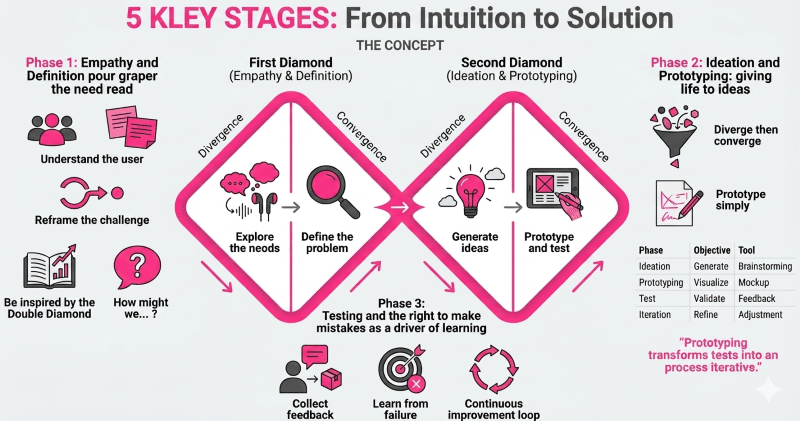
Infographic: The 5 key steps to methodologically move from initial intuition to a concrete, tested solution.
Testing and the right to make mistakes as a driver for learning
Organizing constructive feedback sessions with real users is vital. We must observe their reactions without ever guiding them. Their difficulties reveal product flaws. Valuing failure constitutes a valuable source of data for the company. We often learn more from a failed test than from a success. This allows us to adjust our course quickly. The cycle is never linear; it is fluid and constantly evolving.
We frequently return to empathy after a test. Every bit of user feedback enriches our understanding of the initial need. To evaluate usability, we rely on Jakob Nielsen’s 10 heuristics. These criteria help structure feedback during testing phases and make result analysis more reliable. The importance of rapid iteration allows the solution to be refined without losing time. We correct, we test again, and we progress.
This is the key to a desirable final product. This constant verification approach reinforces alignment around the project. It paves the way for effective multidisciplinary collaboration. This is where collective intelligence comes into play.
Collective intelligence and conditions for successful integration
Adopting design thinking is not just a matter of methodology; it is a profound human and organizational transformation.
The role of the facilitator and multidisciplinary profiles
The facilitator acts as a neutral guide during workshops. They manage the group’s energy and the time allotted. Their mission is to optimize the creative potential of each participant. Mixing technical, marketing, and design profiles helps break down silos. This diversity offers varied perspectives on the same problem. Collective intelligence then becomes a lever for innovation.
The UX designer focuses on the overall user experience, while the project manager coordinates resources and objectives. It is helpful to understand the difference between UX and UI design to clarify roles. IBM emphasizes team alignment through its IBM Enterprise Design Thinking approach. This framework helps large organizations collaborate effectively. The goal remains a shared vision of the project.
Psychological safety is indispensable within the group. Every member must feel free to express themselves without fear of judgment. This favors the emergence of original and authentic ideas. The strength of the collective lies in this human synergy. By combining talents, the company solves complex problems. This is the very core of the human-centered approach.
Overcoming cultural resistance within the company
Several roadblocks often slow down adoption. Fear of uncertainty and rigid hierarchies block agility. A lack of time is also a frequent excuse. To reassure decision-makers, rely on concrete arguments. Highlight how the approach reduces financial risks. The return on investment stems from better customer satisfaction. A gradual rollout is often the best strategy. Launch short pilot projects to demonstrate the method’s effectiveness. Visible results make global buy-in easier. Here are the piliers for transforming internal culture:
- Right to make mistakes to encourage experimentation.
- Co-creation involving all stakeholders.
- Rapid iteration to refine solutions.
- User focus to guarantee product relevance.
The role of design is central to product strategy. You can explore the importance of design in Product Management to deepen this connection. This reinforces organizational coherence. Support from leadership is the final barrier to lift. Without a clear commitment from leaders, the transformation remains superficial. The culture of innovation must infuse every level.
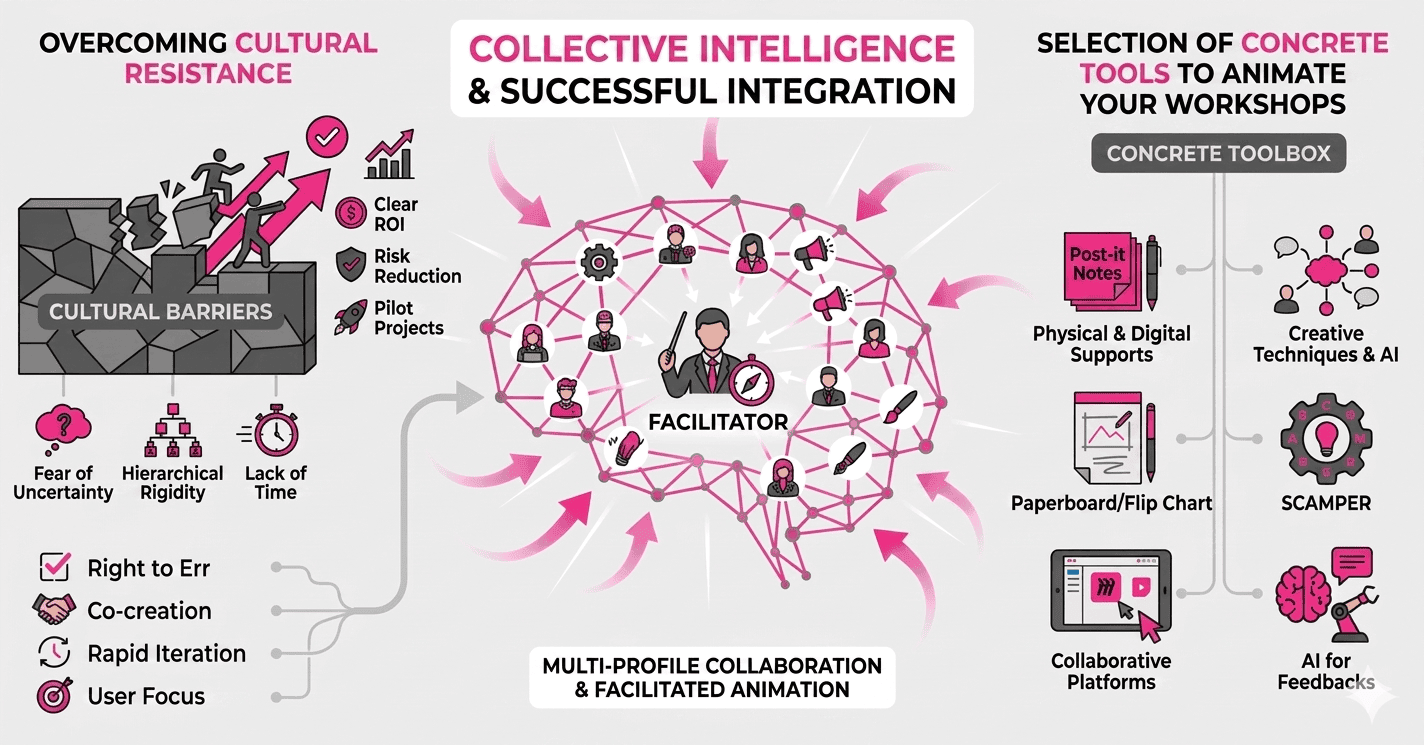
Diagram: Key success factors to activate collective intelligence and the associated facilitation toolbox.
A selection of concrete tools to facilitate your workshops
Physical mediums like post-its and flipcharts remain classics. For remote work, solutions like Miro or Mural are indispensable. They allow for fluid co-creation. Techniques like mindmapping help structure thoughts, and SCAMPER is an excellent tool for stimulating creativity. These methods force teams to look at problems differently. Collaborative platforms facilitate hybrid and asynchronous work, centralizing ideas and feedback in a single location.
This guarantees the continuity of the innovative project. To structure your interfaces, discover what Atomic Design is and its principles. This modular approach perfectly complements the prototyping phases by bringing necessary visual rigor. Artificial intelligence now allows teams to quickly synthesize user feedback, helping identify trends within large volumes of data. This is a valuable time-saver. These tools prepare the ground for execution. Let’s see now how this method compares to other approaches.
Design Thinking, Agile, or Lean: Which Approach to Choose?
Choosing between these methodological frameworks requires understanding their distinct purposes. Here is how to articulate these approaches to transform your ideas into concrete solutions.
Fundamental Differences with Agile and Lean Management
Design thinking focuses on defining the ideal solution. Conversely, the Agile method primarily manages the technical execution of the project. These are two very distinct steps. Yet, these approaches are highly complementary in practice.
Design Thinking often comes in upstream to frame the need before launching iterative development. The major distinction lies in the timeline. Design can involve lengthy research phases, whereas Agile prioritizes short, highly paced sprints. Lean Startup aims primarily to eliminate unnecessary waste, relying heavily on the MVP concept to validate business hypotheses as quickly as possible. To explore these journey concepts further, consult our guide on Service Design – Examples and Applications.
It is a valuable resource for understanding practical implementation. The book Design Thinking for the Greater Good explores these issues, emphasizing the importance of this mindset in solving complex social problems. These methods fit naturally into a global innovation strategy. The idea is to use the right tool at the right time in the lifecycle to create value.
- DT: Explore the problem and understand the human element.
- Lean: Validate the business model and limit losses.
- Agile: Build the product incrementally.
The synergy between these methods guarantees an optimal result. We don’t just build fast; we ensure above all that we are building the right thing for the user.
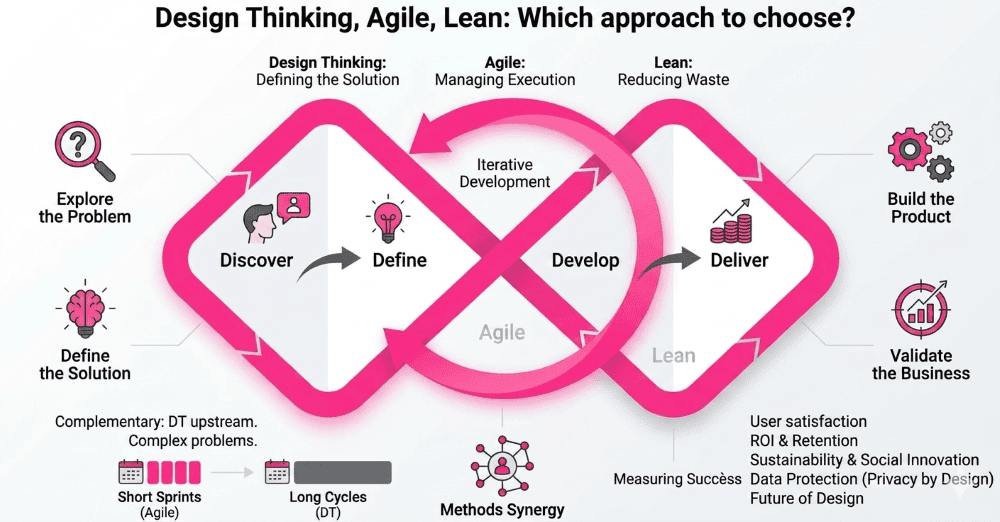
Infographic: Comparative mapping and operational complementarity of Design Thinking, Lean, and Agile approaches.
Relevance criteria and measuring the success of the approach
First, you must determine if the problem is sufficiently complex. We often talk about a “wicked problem” to justify using the method. If the solution is obvious, Design Thinking is unnecessary. Success is measured through precise qualitative indicators. User satisfaction is a central pillar, and we often observe a reduction in customer support complaints.
Evaluating ROI involves analyzing the final experience. Better usability directly boosts customer retention, providing a tangible economic benefit for the organization over the long term. To master these measurement tools, an advanced professional training in UX is highly recommended. It allows you to acquire the necessary skills to pilot these complex projects.
The approach also addresses sustainability. Social innovation is becoming a major criterion for success, aiming to create a positive and lasting impact on society. Data privacy has also become an undeniable standard. Integrating Privacy by Design from the ideation stage is essential, as it strengthens user trust and security.
The core element remains maintaining a strictly human-centered approach. Metrics should never obscure real needs; that is where the true power of innovation lies. The future of design will depend on this ability to reconcile technology and empathy. This is the exciting challenge awaiting the designers of tomorrow. This human-centered approach transforms innovation by balancing desirability, feasibility, and viability. By adopting iterative prototyping and empathy, you reduce the risks of failure while unlocking collective intelligence. Integrate design thinking now to transform your complex challenges into concrete and sustainable successes.
Design Thinking FAQ
What is the concrete definition of Design Thinking?
Design Thinking is a human-centered innovation approach that solves complex problems by drawing inspiration from designers’ methods. This vision of work aims to design solutions that lie at the intersection of three fundamental criteria: user desirability, technical feasibility, and economic viability. Unlike linear project management methods, it prioritizes collective intelligence, empathy, and the right to make mistakes. By using visual and tangible tools, we transform abstract ideas into concrete prototypes to validate real use cases before any massive investment.
What are the key steps in the Design Thinking process?
Although several models exist, the process generally revolves around five iterative phases. It all begins with empathy, where we seek to deeply understand users’ needs and frustrations. Next comes definition, which synthesizes these observations to formulate a clear problem statement, often expressed by the question “How might we?”. The ideation phase then encourages generating a maximum number of creative ideas before moving on to prototyping, which consists of making simplified versions of the solution. Finally, the test phase allows teams to gather user feedback to refine the project. This cycle is non-linear: it is common to return to empathy or ideation following lessons learned from tests.
How does Design Thinking differ from Agile and Lean methods?
These three approaches are complementary but come into play at different times. Design Thinking focuses on exploring the problem and defining the solution (“building the right thing”). Agile, on the other hand, is an execution method that optimizes the iterative and flexible delivery of the product (“building the thing right”). Lean primarily aims to eliminate waste and validate business model viability via the MVP (Minimum Viable Product). In short, we use Design Thinking to understand the user, Lean to validate the market, and Agile to drive technical development responsively.
Why is empathy considered the main pillar of this method?
Empathy is the engine of Design Thinking because it allows us to step away from our own assumptions and adopt the end-user’s point of view. The goal is to capture not only what people say, but especially what they do and feel. This deep understanding helps identify latent needs that consumers cannot always express clearly. To achieve this, we use immersion techniques, such as direct observation or “shadowing,” as well as in-depth qualitative interviews. This phase is crucial to reducing commercial failure risks by ensuring that the solution answers a real, lived problem.
What are the indispensable tools for running a Design Thinking workshop?
To foster co-creation, we use simple physical materials like post-its, markers, and whiteboards, which make ideas tangible. For remote or hybrid work, digital platforms like Miro or Mural are essential to centralize empathy maps, personas, and user journeys. During the ideation phase, methods like SCAMPER or Bono’s Six Thinking Hats help stimulate group creativity. Finally, for rapid prototyping, any material that allows simulating the experience (paper mockups, storyboards, or design tools like Figma) is preferred in order to obtain immediate feedback.