


UX Research or user research are at the heart of any successful strategy lies user experience (UX), and its strongest pillar. Designing digital products and services is not something that can be improvised. This rigorous, scientific process is the compass that guides designers and development teams toward solutions truly adapted to the public’s needs. Rather than relying on assumptions, this approach adopts a user-centered approach, which guarantees the creation of relevant and effective products or services. It is an investigative work that allows one to dive into the user’s world to understand all its nuances, from analyzing user data to understanding the user journey.
Sommaire
What is UX research?
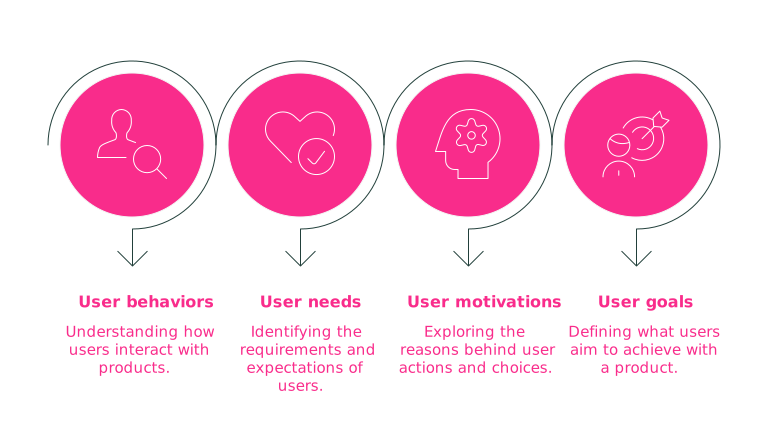
UX research, or user research, is the systematic study of user behaviors, their needs, their user motivations, and their goals. Its main purpose is to gather factual information to inform design and interface optimization decisions. It applies equally to digital products (websites, mobile apps) and physical services.
The exact definition of user research in the UX context
UX research is a discipline that uses a range of UX methods to analyze and understand the project’s target audience.
It involves collecting qualitative data and quantitative data to identify friction points, opportunities for improvement, and user expectations.
The results of this user data analysis are the foundation of any successful design, as they allow for the creation of products that are not only beautiful but also intuitive and useful.
“Good UX research doesn’t validate our ideas; it helps us discover the ones we hadn’t thought of yet.”
By relying on this research, teams can design solutions that precisely address the problems users face, thus transforming a simple idea into an exceptional user experience.
What is the goal of UX research?
The goal of user research is to reduce uncertainty and risks related to product or service design. By understanding user motivations and observing their user behaviors, teams can ensure their design efforts are directed toward the right solutions.
This helps answer fundamental questions such as:
- “Who are our users?”,
- “What are their needs and frustrations?”,
- “How do they interact with our product?”.
UX research aims to align the project’s UX goals with the real needs of users, which translates into higher-performing products, better customer satisfaction, and, ultimately, a better return on investment. This process is an integral part of design thinking, where empathy is the first step of the process and the cognitive load related to the Pareto Principle is the second.
“User experience is the sum of interactions and perceptions. UX research is the method to measure and understand them.”
Why is user research important?
The importance of UX research lies in its ability to anchor design in reality. Without user data analysis, a design project is based on hypotheses, opinions, and intuitions. This can lead to a product that doesn’t find its audience, wastes resources, and fails to solve users’ problems.
User research helps avoid these pitfalls by providing concrete and verifiable information. For example, a UX audit can reveal major usability issues that, once fixed, significantly improve interface optimization. User feedback is an invaluable source of information for continuous improvement because it comes directly from those most concerned with the product.
The evolution of interview and quantitative analysis techniques is the subject of much debate and sharing of methodologies by experts on current top UX design research sites.
Who practices UX research and when?
User research is not an isolated step but a continuous process throughout the design cycle, following an iterative UX methodology.
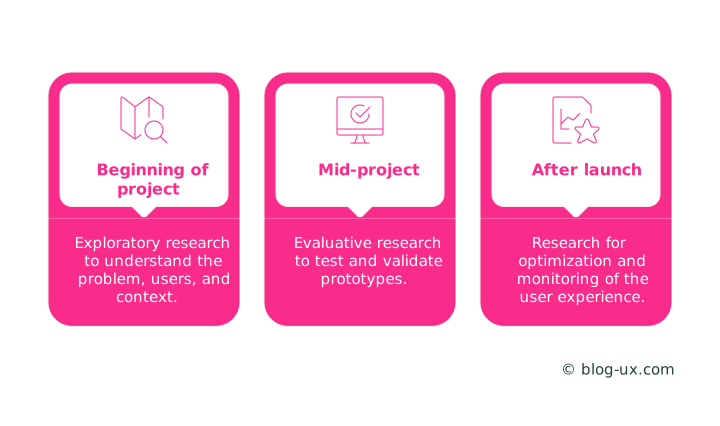
The 3 moments to conduct user research in the design cycle
It can be conducted at different key moments to meet distinct objectives.
At the beginning of a project, it is called exploratory research. The goal is to understand the problem, the users, and the context. This is where semi-structured interviews or user observations are conducted.
Mid-project, evaluative research is used to test and validate prototypes. This is the ideal time for usability testing or guerilla testing.
Finally, after launch, research continues for the optimization and monitoring of the user experience. Customer journey analysis and heatmap studies are then essential for identifying new opportunities.
“The best products are not designed by technology experts, but by experts in understanding humans.”
What skills are required for an UX researcher?
The profession of UX Researcher is multidisciplinary and requires a mix of analytical skills, empathy, and communication. The professional must be capable of defining a solid UX methodology, collecting qualitative and quantitative data, synthesizing it, and presenting the results clearly.
This profile can also be called a Human-Machine Interface (HMI) specialist. They must be comfortable with analysis tools like eye tracking or heatmaps to understand user behaviors. They are also capable of conducting semi-structured interviews with finesse to extract the maximum amount of information regarding user motivations.
Profiles such as the product owner or web project manager may also be required to perform some of these tasks for UX audits or guerilla testing.
“User research is the bridge between what we think we know and what we really need to discover.”
Differences between UX research, UX design, and UI design
| Discipline | Role and responsibilities | Key question |
| UX Research | Investigation and information gathering to understand users and their needs. | “What should we design?” |
| UX Design | Product design based on research findings. Works on information architecture, user journeys, prototypes, and usability testing. | “How to make it easy to use?” |
| UI Design | Visual aspect of the interface (colors, typography, icons). | “How to make it attractive?” |
It is essential not to confuse UX research with UX design or UI design, as they are distinct but complementary disciplines. UX research focuses on investigation and information gathering to understand users and their needs. It answers the question, “What should we design?”
The role of the UX designer is to design the product based on the research results. They work on information architecture, the user journey, prototypes, and usability testing. They answer the question, “How to make it easy to use?”
As for the UI designer, they handle the visual aspect of the interface: colors, typography, icons. They answer the question, “How to make it attractive?”
The synergy between these three roles is the key to a successful user experience, as one informs the strategy, the second the architecture, and the last the aesthetics.
Read this article on the main differences between UX and UI design.
What are the main user research methods?
User research relies on a vast array of UX methods, which can be grouped into two main categories: qualitative methods and quantitative methods. The choice of methods depends on the research objectives and the project context. In-depth analysis often combines several methods for a more complete vision. User research directly fuels the different types of innovation.
“Every research starts with a question, but UX research ends with a better understanding of the users.”
Qualitative methods
Qualitative methods aim to understand the “why” behind user behaviors. They explore motivations, emotions, and contexts of use. They are based on qualitative data and are often conducted on a small sample of users. Among the most common are:
- Semi-structured interviews that allow one to dive into the user’s mind.
- User observations that provide insights into real behaviors in their contextual setting.
- Focus groups that promote collective discussion.
- Creating personas is also an excellent way to synthesize this data into user archetypes.
UX audits and user journey mapping (or customer journey analysis) are other essential methods for visualizing the user journey and identifying pain points.
“User feedback is the oxygen of design. UX research is the system that delivers it to the team.”
Quantitative methods
Quantitative methods, on the other hand, answer the question “how many?”.
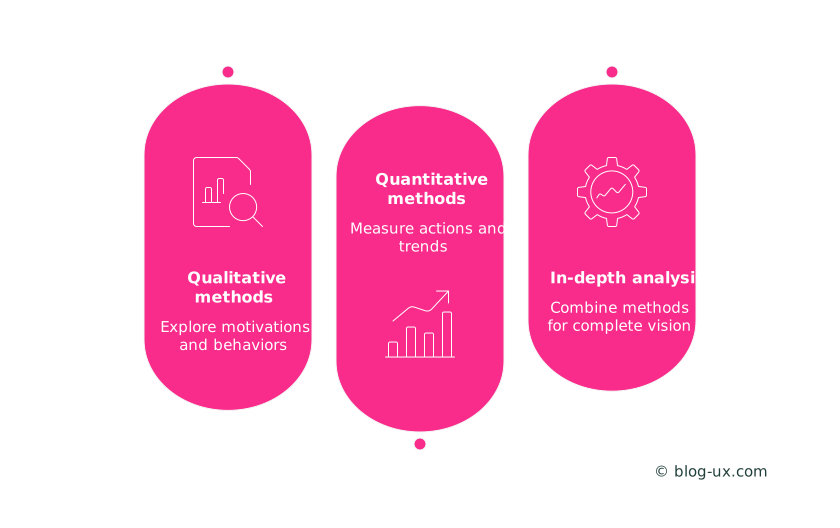
They measure user actions on a large scale and rely on quantitative data to identify statistical trends. Online surveys are an excellent way to collect user feedback quickly. Usability tests, whether in a laboratory or as remote user testing, allow for measuring effectiveness, efficiency, and satisfaction. Guerilla testing is a lightweight and fast version of these tests. Using tools like eye tracking or heatmap analysis allows for accurate UX data visualization of interactions. Competitor analysis can also be a good way to situate the product in the market.
Bonus methods: UX framework and in-depth analysis
In addition to classic methods, UX research uses more specialized tools.
A UX framework can be a guide to structure the research and results. Heuristic analysis is an expert evaluation method based on recognized criteria, such as Jakob Nielsen’s 10 heuristics. To go further, in-depth analysis of user data can use techniques like A/B testing to optimize the interface.
Here is a summary table of the most common user research methods to help you see things more clearly:
| Method | Type | Goal |
| Semi-structured interviews | Qualitative | Understand motivations and context. |
| Online surveys | Quantitative | Measure trends on a large sample. |
| Usability testing | Quantitative | Evaluate interface effectiveness. |
| Eye tracking | Quantitative | Visualize gaze fixation points. |
| Focus group | Qualitative | Gather opinions and group discussions. |
| Heuristic analysis | Qualitative | Evaluate an interface by experts. |
These methods can be used in a complementary way. For example, a user testing session can be followed by an in-depth analysis of the collected user data, and an online survey to confirm the results. It is by combining approaches that one obtains the best synthesis of UX results.
UX Research Case Studies
To concretely illustrate the impact of UX Research on a product’s success, let’s dive into a few case studies.
Take the example of a mobile banking app that initially suffered from a low adoption rate. The team conducted in-depth semi-structured interviews and usability tests, revealing that users were overwhelmed by a too-complex interface and poorly prioritized features. In response, a redesign based on this user feedback simplified the customer journey, making common operations more accessible. The result? A 40% increase in engagement and a notable improvement in customer satisfaction, proving that investing in research is an essential growth lever.
Another case concerns a fashion e-commerce platform. Despite an attractive offering, cart abandonment was rampant. Heatmap analysis and eye-tracking highlighted navigation difficulties and product information deemed insufficient. By integrating more intuitive filters, 360° visuals, and more visible customer reviews, the platform transformed its shopping experience. The conversion rate jumped by 25%, demonstrating that user data analysis is crucial for unlocking commercial potential. These adjustments, guided by rigorous research, turned friction points into loyalty-building opportunities.
Finally, a B2B software company managed to reverse a churn trend by investing in in-depth exploratory research. Focus groups revealed that users struggled to understand key features, despite their power. Rather than adding new options, the UX team simplified existing workflows and created interactive tutorials based on the identified pain points. This user-centered approach not only reduced churn by 15% but also generated positive word-of-mouth, attracting new clients. These concrete examples underscore that UX Research is not a cost, but a strategic investment that guarantees the relevance and performance of digital products and services.
UX Research Tools
Beyond methodologies, the effectiveness of UX research also relies on the use of high-performance UX tools and software platforms. These digital instruments have become indispensable for UX Researchers, allowing them to collect, analyze, and present user data with increased precision and speed. Whether it’s surveying a large audience, conducting remote usability tests, or interpreting complex behaviors, technology offers a range of solutions adapted to every stage of the research process.
For online surveys, platforms like SurveyMonkey, Typeform, or Google Forms are valuable allies, offering intuitive interfaces for creating custom questionnaires and collecting quantitative data on a large scale. They facilitate respondent segmentation and data export for in-depth analysis. In parallel, user testing tools like UserTesting, Maze, or Lookback allow for conducting remote sessions, recording user interactions, and gathering real-time feedback, thus offering invaluable qualitative insights into the user journey.
Data analysis also benefits from specialized software. Google Analytics remains a must-have for tracking behavior on websites, while tools like Hotjar or FullStory offer heatmaps, session recordings, and in-app surveys for a visual and contextual understanding of interactions. For managing and synthesizing qualitative data, platforms like Dovetail or EnjoyHQ help researchers organize their observations, identify trends, and create clear and impactful reports. Adopting these UX tools not only optimizes research time but also enriches the quality of discoveries, transforming raw data into actionable design strategies.
UX Research Ethics
Ethics in UX research is a fundamental pillar, ensuring that every user research is conducted with integrity and respect. Beyond methods and objectives, the ethical dimension ensures the protection of participants and the reliability of results. It encompasses essential principles that must guide every step of the process, from planning to the dissemination of findings. Ignoring these considerations could not only harm a project’s reputation but also compromise user trust, an invaluable asset in the digital world. An ethical approach strengthens the credibility of insights and the value of the resulting design decisions.
Data privacy is a major concern in UX research. It is imperative to ensure that all collected information, whether qualitative or quantitative, is handled with the utmost discretion. This involves anonymizing data when possible, securing storage, and complying with regulations in force, such as the GDPR. Informed consent from participants is another cornerstone: every individual must fully understand the purpose of the research, how their data will be used, and have the freedom to withdraw at any time without consequence. Clear and transparent information is essential for building a relationship of trust. Finally, the researcher’s neutrality is crucial to avoid bias. The UX researcher must strive to adopt an objective stance, avoiding influencing participants’ responses or interpreting results subjectively. This rigor ensures that insights faithfully reflect the reality of users and not the design team’s expectations. By integrating these ethical principles, we build products that are not only effective but also respectful of human beings.
Key Takeaways
UX research is much more than just a project step: it is the essence of a user-centered approach. It allows for understanding user behaviors, their needs, and their frustrations to create relevant and effective products. By using qualitative and quantitative methods like usability tests, semi-structured interviews, or user data analysis, UX professionals can make informed decisions. User research is the foundation of a successful user experience, which, in turn, fosters loyalty and growth. It distinguishes itself from UX design and UI design by its role of investigation and analysis, acting as the guide that lights the path for the entire design and interface optimization process.