


Parkinson’s law is a well-known concept in time management, which states that “work expands so as to fill the time available for its completion.” In other words, the more time you have to complete a task, the longer that task will take. This phenomenon may seem trivial, but it has profound implications for our efficiency and productivity. Understanding and managing this principle can significantly improve your use of time.
Sommaire
Origin of Parkinson’s law
History and context
Parkinson’s Law was formulated by Cyril Northcote Parkinson, a British historian and writer, in a humorous essay published in 1955 in “The Economist.” Parkinson observed the inefficiencies of the British public administration and how bureaucratic tasks tended to expand to fill all available time. His observation, although satirical, found deep resonance in many aspects of time management and productivity.
The author: Cyril Northcote Parkinson
Cyril Northcote Parkinson was not only a perceptive observer of human behavior but also a sharp critic of bureaucratic inefficiencies. His work has influenced many modern theories on time management and productivity, making Parkinson’s Law a key principle for those seeking to optimize their use of time.
Key takeaways
|
Read the full article on all the UX laws you need to know!
What are the principles of Parkinson’s law?
[Image of diagram illustrating Parkinson’s Law time management]

Source
This diagram illustrates the difference in effort distribution over time between two techniques, T1 and T2.
- Top graph (T1): Efforts are concentrated at the beginning of the period, with a peak of intensity followed by a rapid decrease. This reflects an approach where the initial effort is intense (represented by the color red) and decreases rapidly toward the end.
- Bottom graph (T2): Efforts are distributed more evenly over the entire period, with a less pronounced peak and a more gradual decrease. This method, illustrated in blue, shows a more balanced distribution of efforts over time.
The vertical axis represents the intensity of efforts, while the horizontal axis represents time. Points D and I indicate the beginning and end of the effort, respectively.
Definition of Parkinson’s lawParkinson’s Law states that “work expands so as to fill the time available for its completion.” This means that if you have a week to accomplish a task that could be finished in two hours, it is likely that you will take the entire week to complete it. This phenomenon is due to the human tendency to adjust effort and focus based on the time available. |
Concrete example
Let’s take a concrete example: if you have to write a report and you have two weeks to do it, instead of starting immediately and finishing it quickly, you might procrastinate, unnecessarily perfect every detail, and eventually use the full two weeks. It could have been finished in just a few days if tighter deadlines had been imposed.
Why is Parkinson’s Law relevant today?
Parkinson’s Law is particularly relevant today for several reasons, mainly due to the rapid changes in our lifestyles and work patterns.
Proliferation of digital distractions
With the advent of digital technologies and social media, distractions are omnipresent. Constant notifications, emails, and social platforms can easily divert attention and expand the time needed to complete a task. Parkinson’s Law then manifests as work expanding to fill the available time, often interrupted by these distractions.
Increased work flexibility
Remote work and flexible hours have become common in many industries. Although this flexibility can offer significant benefits, it can also lead to poor time management. Without a strict structure, tasks can stretch to fill the entire workday, making Parkinson’s Law particularly relevant for those who work independently.
Increased multitasking responsibilities
Today, professionals often juggle multiple responsibilities and projects simultaneously. This situation can lead to a tendency to delay certain tasks, giving them more time than they really require. Parkinson’s Laws explain how and why these tasks end up occupying all available time, often at the expense of other important activities.
Productivity pressure
There is constant pressure to be productive and efficient in the modern world. This pressure can paradoxically lead to counter-productive behaviors, such as micromanaging tasks and disguised procrastination. By giving more time than necessary to a task under the pretext of perfection-seeking, one ends up confirming Parkinson’s Law.
Increasing task complexity
Today’s tasks and projects are often more complex and interconnected, requiring careful coordination and numerous adjustments along the way. This complexity can easily lead to delayed deadlines if clear limits are not set. Parkinson’s Law is relevant here because it highlights the natural tendency to let these complex tasks expand indefinitely.
Stress and burnout
Work-related stress and burnout are major issues of our time. Inefficient time management, exacerbated by Parkinson’s Law, can contribute to these problems. By not setting precise deadlines and allowing tasks to expand, we increase stress and reduce time available for rest and recovery.
Need for effective time management
In a world where demands are multiple and time always seems to be in short supply, effective time management is more crucial than ever. Parkinson’s Law underscores the importance of setting strict deadlines and sticking to them to improve productivity and maintain a healthy work-life balance.
The impacts of Parkinson’s law on time management
Parkinson’s Law has significant impacts on how we manage our time, influencing both our productivity and our well-being.
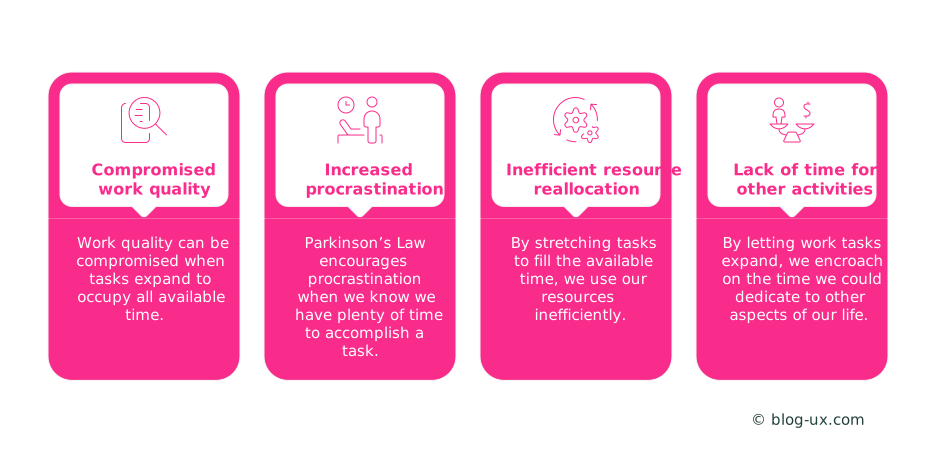
Compromised work quality
Work quality can be compromised when we allow tasks to expand to occupy all available time. Last-minute work is often rushed, which can lead to errors and omissions. Furthermore, when we spend too much time on non-essential details, we risk losing sight of the main goal and neglecting the most important aspects of the project.
Increased procrastination
Parkinson’s Law encourages procrastination. When we know we have plenty of time to accomplish a task, we are more inclined to put it off. This procrastination can lead to periods of intense last-minute work, which can be a source of stress and harm the quality of the work. For example, a student who has a month to submit a project might spend the first three weeks procrastinating, then work frantically the last week.
Inefficient resource reallocation
By stretching tasks to fill the available time, we use our resources inefficiently. This includes not just time, but also energy and focus. Instead of concentrating our resources on the most important and urgent tasks, we dissipate them on tasks that could be accomplished more quickly. For example, a manager who spends too much time on detailed weekly reports may neglect crucial strategic decisions.
Lack of time for other activities
Another major impact of Parkinson’s Law is the lack of time for other activities. By letting work tasks expand, we encroach on the time we could dedicate to other aspects of our life, such as hobbies, family, or personal development. This can lead to an imbalance between work and personal life, affecting our overall satisfaction and quality of life.
Difficulty prioritizing
Parkinson’s Law can also make prioritizing tasks difficult. When all tasks expand to fill the available time, it becomes hard to determine which tasks are truly the most important and urgent. This can lead to a dispersion of efforts and general inefficiency. For example, an entrepreneur who lets every daily task expand may struggle to focus on long-term goals crucial for the growth of their business.
Creation of a false impression of productivity
Finally, Parkinson’s Law can create a false impression of productivity. By working longer on a task, we may feel very busy and productive, while in reality, we could have accomplished the same task in much less time with better time management. This illusion of productivity can prevent us from seeking more efficient ways to work.
How to counter Parkinson’s law?
Set realistic deadlines
To prevent tasks from expanding unnecessarily, it is crucial to set realistic deadlines and stick to them. By limiting the time allocated to each task, you are more likely to work in a more focused and efficient manner. For example, if you have a presentation to prepare, set a deadline of a few hours rather than several days to stay focused and avoid distractions.
Planning techniques
Using planning techniques like the Pomodoro method, which involves working in 25-minute intervals followed by short breaks, can help maintain focus and avoid task expansion. This technique encourages periods of intense work followed by regular breaks, which helps maintain a high level of productivity.
Use time management tools
Time management tools, such as electronic calendars, to-do lists, and project management apps, can greatly help track deadlines and stay organized. For example, apps like Todoist or Trello allow you to create task lists with clear deadlines and reminders to stay on track.
Read this article on Jakob Nielsen’s heuristics for ergonomics
Prioritization methods
Table of prioritization methods to counter Parkinson’s Law
| Prioritization method | Description | Concrete examples |
| Eisenhower Matrix | Divides tasks into four categories: urgent and important, important but not urgent, urgent but not important, and neither urgent nor important. | Urgent/Important: Answer a critical client email before the end of the day. Important/Not Urgent: Plan long-term skill development. Urgent/Not Important: Reply to less important instant messages. Neither: Browse social media without a goal. |
| ABC Method | Ranks tasks by priority: A (very important), B (important), and C (less important). | A: Prepare a presentation for a major client. B: Organize a weekly team meeting. C: Archive old documents. |
| 80/20 Rule (Pareto Principle) | Suggests that 80% of results come from 20% of efforts. Focus on the most impactful tasks. | 20% of effort: Develop key product features that drive the most sales. 80% of results: Generate significant revenue through these main features. |
| Pomodoro Technique | Divides work into short, focused intervals (usually 25 minutes), followed by short breaks. | 25 Minutes: Write a project report without interruption. 5-Minute Break: Stand up and stretch before starting another 25-minute session. |
| MoSCoW Method | Prioritizes tasks: Must have, Should have, Could have, and Won’t have. | Must Have: Deploy a critical security update. Should Have: Add an additional feature that improves user experience. Could Have: Revise the website’s aesthetics. Won’t Have: Postpone a minor, non-urgent improvement. |
| SMART Goals | Defines Specific, Measurable, Achievable, Relevant, and Time-bound objectives. | Specific: Increase web traffic by 10%. Measurable: Use Google Analytics. Achievable: Implement an SEO strategy. Time-bound: Achieve this in six months. |
| Kanban Method | Uses visual boards to manage tasks (To Do, In Progress, Done). | To Do: Create slides for a presentation. In Progress: Currently designing slides. Done: Finalized and ready. |
| 1-3-5 Rule | For each day, choose 1 main task, 3 medium tasks, and 5 small tasks. | 1 Main: Finalize annual report. 3 Medium: Reply to emails, prepare a meeting, follow-up calls. 5 Small: Tidy desk, organize files, check voicemail, quick notes, reading. |
| Zen to Done (ZTD) | A simplified version of GTD, focusing on the habit of capturing and completing tasks. | Capture: Note ideas and tasks immediately. Complete: Focus on one task at a time. |
| Getting Things Done (GTD) | Task management in five steps: collect, process, organize, review, and act. | Collect: Gather all tasks in one place. Process: Decide the necessary action. Review: Regular checks to adjust priorities. Act: Accomplish tasks. |
Adopting a productivity mindset
Importance of discipline
To manage your time effectively, discipline is essential. Establishing routines and sticking to them, even when the temptation to procrastinate is strong, is crucial for maintaining high productivity. For example, starting each day with the most important tasks can help avoid procrastination and maintain a good work rhythm.
Cultivate productive habits
Adopting productive habits, such as avoiding digital distractions during work hours, taking regular breaks to recharge, and setting clear goals, can greatly improve efficiency. For example, turning off phone notifications during work periods can help you stay focused and productive.
Case studies and practical examples
Company examples
Many companies have adopted time management techniques to improve productivity. For example, Google encourages its employees to dedicate 20% of their time to personal projects, which stimulates creativity and innovation. This approach shows how flexible and thoughtful time management can lead to exceptional results.
Personal testimonials
Many people testify to the benefits of effective time management. For example, Marie, a mother and executive in a large company, managed to balance work and personal life through prioritization techniques. Using tools like the Eisenhower Matrix, she was able to improve her productivity while reserving quality time for her family.
Parkinson’s law and work-life balance
Time management at home
Parkinson’s Law also applies to time management at home. For example, if you have the whole weekend to clean the house, you risk taking the whole weekend. By setting specific time slots for each household task, you can accomplish more in less time and free up time for more enjoyable activities.
Importance of free time
It is crucial to preserve free time to relax and recharge. Effective time management allows you to free up moments of quality for yourself and your loved ones, which is essential to maintain a good work-life balance.
Digital tools to improve time management
Task management applications
Applications like Todoist, Trello, and Asana can help you organize and track your tasks, ensuring better time management. These tools allow you to create task lists, set deadlines, and track project progress.
Time tracking software
Software like RescueTime or Toggl allows you to track how much time you spend on different activities, helping you identify and eliminate time-wasters.
Conclusion
Parkinson’s Law reminds us that time is a precious ally that must be managed wisely. By understanding this law and adopting effective time management strategies, you can improve not only your productivity but also your quality of life.
FAQ: Parkinson’s law & productivity
Why does work naturally expand? It is a psychological reflex: without a time limit, our brain occupies available space by complicating the task, procrastinating, or getting lost in perfectionism.
Does reducing deadlines hurt quality? Not necessarily. According to this law, a tight deadline forces you to focus on the essentials. Conversely, a deadline that is too long encourages the addition of superfluous details that provide no real value.
What is the link to the Pomodoro method? The Pomodoro method (working in 25-minute blocks) is a direct countermeasure: it creates “micro-deadlines” that force the brain to remain productive to finish the sequence before the timer rings.
How to set a “realistic” deadline? Evaluate the time needed if you were in an emergency situation, then add a small safety margin. The goal is to feel slight pressure without generating paralyzing stress.
Does this law also apply to personal life? Yes. If you give yourself all Saturday to do the cleaning, it will take all day. If you force yourself to finish by 10 AM to go out, you will be much more efficient.
Featured Image: Dribbble Muinat