


Sports betting site interfaces represent a unique challenge in ergonomic engineering within today’s digital landscape. Unlike a traditional content site or an online store, a betting platform must manage a massive flow of real-time data while providing absolute responsiveness. Transitioning from the wide screen of a desktop computer to the restricted surface of a smartphone cannot be summarized as a simple proportional reduction of elements.
Sommaire
The transition from desktop to mobile: a paradigm shift
On a desktop computer, the designer has a generous surface area allowing for the simultaneous display of the sports list, live events, the betting slip, and promotional banners. The user navigates with a mouse, a tool of surgical precision that allows for dense clickable areas, a layout often highlighted in an Aerobet review for its comprehensive data density. When switching to mobile, this architecture collapses. Spatial constraints force drastic choices: what should be shown immediately and what should be hidden behind contextual menus?
The major challenge lies in managing informational density. A single football match can offer over two hundred betting variants (exact score, scorers, number of corners, etc.). On PC, these options are often displayed in large tables. On mobile, the design must adopt an accordion structure or a horizontal tab navigation system to avoid the effect of “scroll fatigue.” The goal is to reduce the cognitive load on the bettor who, often in the urgency of a live event, must find a specific odd without being distracted by secondary information.
Tactile ergonomics at the service of execution speed
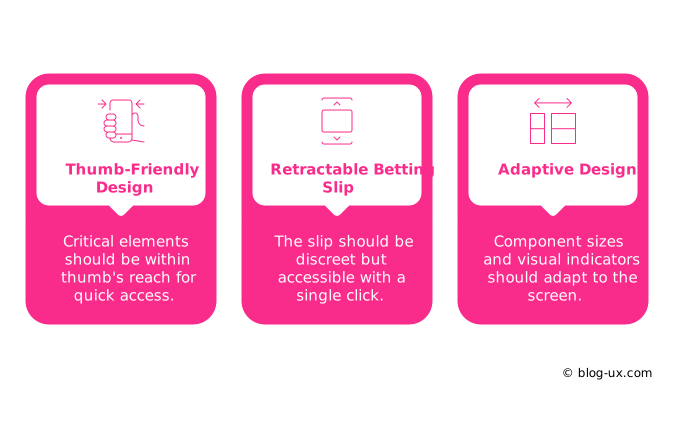
The shift to touch controls requires rethinking the “comfort zone” of the hand. Unlike desktop navigation, mobile design for sports betting must place critical elements, such as the bet validation button or live access, within thumb’s reach. This is known as “thumb-friendly” design. If a user has to use both hands to finalize a bet, the interface has failed its mission of fluidity.
Managing the retractable betting slip
One of the most significant innovations in recent years is the floating or retractable betting slip (bet slip). On a desktop site, the slip is usually fixed in a column on the right, permanently visible. On a smartphone, it must remain discreet to make room for navigation while staying accessible in a single click. Designers often opt for a persistent bar at the bottom of the screen that indicates the number of current selections. A tap on this bar expands the slip to full screen, allowing the user to enter their stake and validate. This approach preserves visual space while keeping the primary conversion function within reach.
Hierarchy through adaptive design
Responsive design is not just about moving blocks; it must also adapt the size of components. Odds buttons, for example, become large and spaced-out tactile targets to avoid selection errors. In the context of live betting, these buttons must also integrate clear visual indicators (green or red arrows) to signal changes in odds without the user needing to refresh the page. The use of micro-animations then becomes an essential communication tool to keep the player informed of the market status.
Comparison of interface elements by device
To better understand the evolution of components, it is helpful to visualize how major features are redistributed between the two types of screens.
| Element | Desktop interface | Mobile interface |
| Sports menu | Fixed left sidebar | Hamburger menu or horizontal icons |
| Bet placement | Always visible side window | Retractable overlay or bottom bar |
| Video streaming | Large central integrated window | Floating player or full-screen mode |
Technical optimization for responsive design
Beyond the visual aspect, adapting a sports betting site to mobile relies on a robust technical infrastructure. Loading speed is a decisive conversion factor. A bettor wishing to wager on the end of a match will not tolerate a three-second loading delay. The design must therefore be lightweight, prioritizing CSS code and vector icons (SVG) over heavy images that consume bandwidth.
The use of technologies such as Progressive Web Apps (PWA) allows for simulating a native application experience while staying within the mobile browser. This offers benefits such as intelligent resource caching and the ability to send push notifications to inform the player of a win or an upcoming match. This convergence between web and app is the pinnacle of successful responsive design in the gaming industry.
The challenges of real-time data display
One of the biggest obstacles for mobile design is the display of detailed statistics. Modern bettors rely on possession data, shots on target, and team lineups to make their decisions. On a desktop screen, these charts can be displayed alongside the odds. On mobile, the design must often hide this data behind an “info” icon or use swipe gestures to toggle between odds and statistics. The difficulty is maintaining visual consistency so that the user never feels lost during these rapid transitions.
- Prioritize the most popular sports at the top of the mobile screen via a favorites menu.
- Use highly legible typefaces, even at small sizes, for odds numbers.
- Implement a dark mode to reduce eye strain during night sessions.
The future of the nomadic user experience
Adapting the interface of sports betting sites from PC to mobile is no longer an option, but the very foundation of an operator’s survival. The future lies in even deeper personalization, where the responsive interface does not just adapt to screen size, but also to the player’s consumption habits. By simplifying pathways, optimizing speed, and respecting the codes of tactile ergonomics, platforms turn a technical constraint into a true loyalty lever, offering a fluid experience that erases the boundary between the office and mobility.
FAQ
Why does the side menu disappear on mobile?
To maximize the central space dedicated to odds, the side menu is generally replaced by a “hamburger” menu or a navigation bar located at the top or bottom of the screen.
Is the loading time longer on a smartphone?
Normally no, as mobile versions use optimized assets and lightweight scripts to ensure optimal responsiveness, even on 4G or 5G connections.
Can we watch live matches on the mobile interface?
Yes, modern interfaces integrate adaptive video players that resize or switch to full screen to provide a comfortable viewing experience.
Are all betting options available on mobile?
The goal of responsive design is to offer 100% of the markets available on PC, although their visual organization is different to avoid clutter.
Is the betting slip automatic?
On most mobile sites, clicking on an odd automatically adds the selection to a floating slip that remains accessible with a simple gesture at the bottom of the page.